
GOOGLE's “Willow”- A Quantum Computing Marvel


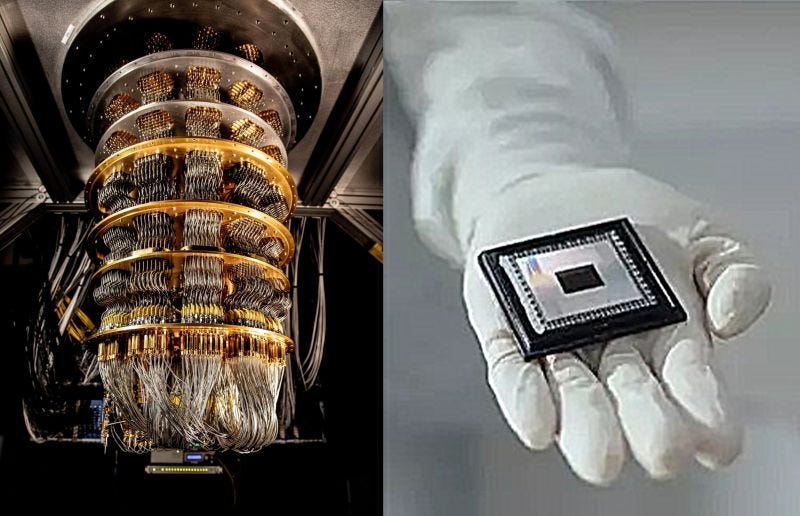
Google’s new quantum chip ''Willow'' can solve problems in under 5 minutes that would take 10 septillion years ( 25 zeros on 1 i.e. 10,000,000,000,000,000,000,000,000 ) for the world’s fastest supercomputer.
In 2019, Google's ''Sycamore'' processor made history by performing a complex task in 200 seconds that would take a classical supercomputer 10,000 years.
Now, Google has pushed the boundaries even further with its latest quantum processor - Willow.
Willow has 105 qubits. Sycamore had 53 qubits.
This massive leap in qubits helps reduce calculation errors and brings quantum computing closer to real-world applications.
What could this mean?
Imagine training AI systems faster than ever, discovering life-saving drugs in record time, curing diseases, creating sustainable energy solutions, and optimizing industries like transportation and logistics. The possibilities are endless.
Just to put it into perspective, 10 septillion years is 10,000,000,000,000,000,000,000,000 years. We could never have imagined computing power like this.
This isn’t just speed—it’s a revolution in how we solve problems.
This is strong 💪 it will give humanity a whole new spin.
In The Hitchhiker's Guide to the Galaxy, the answer to the "Ultimate Question of Life, the Universe, and Everything" is 42, as calculated by the fictional supercomputer Deep Thought. However, the meaning of this number is never revealed in the story, leaving it open to individual interpretation.
Douglas Adams, the author of The Hitchhiker's Guide to the Galaxy, advocates for accepting meaninglessness in the face of existential questions, but also emphasizes that the impulse to explore these questions is a natural part of being alive.
The Theory of Nothingness
The humans create meaning in an otherwise "nothing-filled" universe.
Shunyavad(शून्यवाद) in Buddhism states that there is no spirit, whether human or supreme. It is also a theory that consciousness lacks corresponding objects.
Advaita Vedanta discusses "nothingness" as the dissolution of individuality into the infinite Brahman (अहम् ब्रह्मास्मि) , transcending the material illusion (Maya) .
In Physics, "nothing" is studied in terms of vacuum states, quantum fields, and the concept of "something from nothing" in cosmology.
Quantum computing and Artificial intelligence (AI)
Quantum computing and Artificial intelligence (AI) are complementary fields that, when combined, can enhance the capabilities of each.
Quantum computing has the potential to process vast amounts of data and solve complex problems at speeds far beyond classical computers. This can significantly accelerate AI algorithms, particularly those involving machine learning and deep learning. For instance, quantum algorithms can potentially optimize training processes for AI models, allowing faster and more efficient pattern recognition and data analysis.
AI can be used to design better quantum algorithms, streamline quantum circuit layouts, and optimize the performance of quantum hardware. Machine learning models can predict which configurations and processes will result in the most efficient quantum operations.
Quantum algorithms can analyze large-scale financial data for risk assessment, portfolio optimization, and fraud detection.
Quantum computing can simulate molecular structures and interactions at an unprecedented level of detail, aiding AI in drug discovery and the development of personalized medicine.
Quantum computing can optimize complex logistical operations by handling numerous variables simultaneously, and AI can then adapt and apply these solutions in real-world scenarios, enhancing decision-making and process efficiency
As quantum technology matures, we can expect deeper integration between AI and quantum computing to unlock innovations that are currently unattainable with classical computing alone.